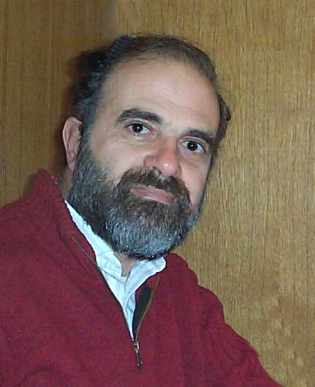
 Giuseppe Longo is currently a Senior Research Scientist at CNRS. He is working at the CREA, Ecole Polytechnique et au CIRPHLES of ENS Ulm in Paris. He’s the head of the CIM team (Complexité et information morphologiques).
The main research area Longo has been interested in concerns syntactic and semantic properties of the “logical base” of functional languages: Combinatory Logic, Lambda-calculus and their extensions. However, he always investigated these topics in its broadest setting which relates them to Recursion Theory, Proof Theory and Category Theory.
In this perspective, Longo worked at some aspects of Recursion Theory, Higher Type Recursion Theory, Domain Theory and Category Theory as part of a unified mathematical framework for the theory and the design of functional languages. In a sense, Longo has always been mostly interested in the “interconnecting results” or “bridges” and applications among different areas and to language design. He also worked at the applications of functional approaches to Object Oriented programming.
He is currently extending his interdisciplinary interests to Philosophy of Mathematics, Biology and Cognitive Sciences. The main project in these areas is an interdisciplinary initiative on Geometry and Cognition (started with the corresponding grant: “Géométrie et Cognition”, 1999 - 2002), focusing on the geometry of physical and biological spaces. The developements of this project lead to a new initiative at DI-ENS, in 2002, the setting up of the research team “Complexité et information morphologiques” (CIM), centered on foundational problems in the interface between Mathematics, Physics and Biology. The main recent advances concern mathematical analyses in Systems Biology.
Turing: ‘Le ‘human computer’, la machine à états discrets, la genèse des formes
La machine proposée par Turing en 1936 fonde son efficacité et son succès sur la rupture fondamentale et la distinction entre le matériel et le logiciel. Cette idée fut originellement proposée comme une pure abstraction mathématique. Elle devient plus tard le coeur de la structure même sur laquelle se fonde l’universalité et l’efficacité du calcul : un matériel “rigide (hardware)” permet à un logiciel ”immatériel (software)” de s’exécuter.
Après le seconde guerre mondiale, alors que Turing s’intéresse de nouveau à la physique, il met en évidence la caractéristique clef de sa machine : c’est une machine à état fini -une DSM comme il dit (Discrete State Machine). Il travaille ensuite avec des structures physiques complètement différentes, pour son analyse de la morphogenèse (1952) : les systèmes continus comme il les nomme. Ses systèmes composés d’action, de réaction et de diffusion vont permettre une plus grande connaissance et une meilleur compréhension de systèmes physiques et biologiques, pour lesquels le “calcul” réside entièrement dans des dynamiques continues de formes. Il n’est plus question de logiciel immatériel, mais d’une plastique et d’un matériel imprévisible en constante évolution.
On mettra en évidence le génie et l’audace d’un penseur qui sait radicalement changer de cap et d’outils, en se confrontant à une phénoménalité différente - tout en gardant la richesse de ses inventions précédentes.
More information on Giuseppe Longo‘s web site.
Bibliography (downloadable here)
- G. Longo. Critique of Computational Reason in the Natural Sciences, In “Fundamental Concepts in Computer Science” (E. Gelenbe and J.-P. Kahane, eds.), Imperial College Press/World Scientific, pp. 43-70, 2009
- G. Longo. L’informatique aux interfaces des savoirs. A paraître aux actes du Colloque de 2009 “Quelques interactions logique/monde”, Paris, 2012.
- Giuseppe Longo. Laplace, Turing and the “imitation game” impossible geometry: randomness, determinism and programs in Turing’s test. In Epstein, R., Roberts, G., & Beber, G. (Eds.). Parsing the Turing Test, pp. 377-413, Springer, 2008.
- Giuseppe Longo. From exact sciences to life phenomena: following Schrödinger and Turing on Programs, Life and Causality. Concluding lecture at “From Type Theory to Morphological Complexity: A Colloquium in Honor of Giuseppe Longo.” In Information and Computation, special issue, n. 207, pp. 545-558, 2009.


